Paris is the capital and most populous city of France. It is situated on the River Seine, in the north of the country, at the heart of the Île-de-France region. Within its administrative limits (the 20 arrondissements), the city had 2,234,105 inhabitants in 2009 while its metropolitan area is one of the largest population centres in Europe with more than 12 million inhabitants.
Best Attactions in Paris
Once the tallest structure in the world, the Eiffel Tower is probably Europe's best known landmark and Paris's most famous symbol.
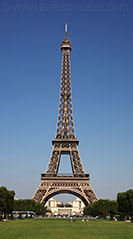
You couldn't possibly visit Paris without seeing the Eiffel Tower. Even if you do not want to visit this world famous structure, you will see its top from all over Paris. The tower rises 300 meters tall (984 ft); when it was completed at the end of the nineteenth century it was twice as high as the Washington Monument, at the time the tallest structure in the world.
1889 World Exhibition
The Eiffel Tower was built for the World Exhibition in 1889, held in celebration of the French Revolution in 1789.
The construction was only meant to last for the duration of the Exposition, but it still stands today, despite all protests from contemporary artists who feared the construction would be the advent of structures without 'individuality' and despite the many people who feared that this huge 'object' would not fit into the architecture of Paris.
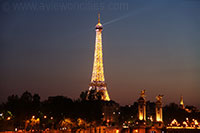 Today, there is no such aversion anymore among the Parisians, and one could not imagine Paris without the Eiffel Tower, in fact it has become the symbol of the City of Light.
The construction was only meant to last for the duration of the Exposition, but it still stands today, despite all protests from contemporary artists who feared the construction would be the advent of structures without 'individuality' and despite the many people who feared that this huge 'object' would not fit into the architecture of Paris.
Gustave Eiffel
The man behind the Eiffel Tower was Gustave Eiffel, known from his revolutionary bridge building techniques, as employed in the great viaduct at Garabit in 1884. These techniques would form the basis for the construction of the Eiffel Tower. He was also known for the construction of the Statue of Liberty's iron framework.
The structure took more than two years to complete. Each one of the about 12,000 iron pieces were designed
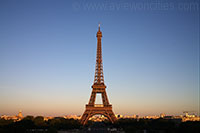 separately to give them exactly the shape needed. All pieces were prefabricated and fit together using approx. seven million nails.
The structure took more than two years to complete. Each one of the about 12,000 iron pieces were designed
The Tallest
Inaugurated March 31, 1889, the Eiffel Tower would be the tallest structure in the world until the completion of the Chrysler Building in 1930.
The Louvre, originally a royal palace but now the world's most famous museum, is a must-visit for anyone with a slight interest in art. Some of the museum's most celebrated works of art include the Mona Lisa and the Venus of Milo.
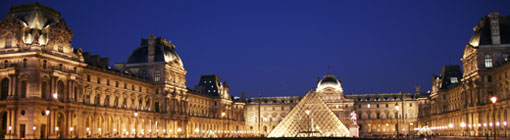
The Louvre Museum is one of the largest and most important museums in the world. It is housed in the expansive Louvre Palace, situated in the 1st arrondissement, at the heart of Paris.
Louvre Museum
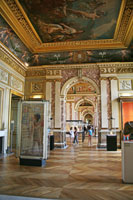
Louvre Interior
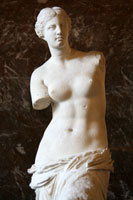
Venus of Milo
The collection of the Louvre Museum was first established in the 16th century as the private collection of King Francis I. One of the works of art he purchased was the now famous Mona Lisa painting. The collection grew steadily thanks to donations and purchases by the kings. In 1793, during the French Revolution, the Louvre became a national art museum and the private royal collection opened to the public.
The museum has a collection of over 1 million works of art, of which about 35 000 are on display, spread out over three wings of the former palace. The museum has a diverse collection ranging from the Antiquity up to the mid 19th century.
Some of the most famous works of art in the museum are the Venus of Milo, the Nike of Samothrake, the Dying Slave by Michelangelo and of course Leonardo da Vinci's Mona Lisa.
After entering the museum through the Louvre Pyramid or via the Carrousel du Louvre, you have access to three large wings: Sully, Richelieu and Denon. Below a brief description of the highlights in each wing.
The museum has a collection of over 1 million works of art, of which about 35 000 are on display, spread out over three wings of the former palace. The museum has a diverse collection ranging from the Antiquity up to the mid 19th century.
Some of the most famous works of art in the museum are the Venus of Milo, the Nike of Samothrake, the Dying Slave by Michelangelo and of course Leonardo da Vinci's Mona Lisa.
After entering the museum through the Louvre Pyramid or via the Carrousel du Louvre, you have access to three large wings: Sully, Richelieu and Denon. Below a brief description of the highlights in each wing.
Sully Wing
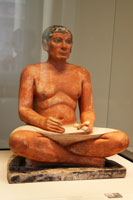
Seated Scribe
The Sully wing is the oldest part of the Louvre. The second floor holds a collection of French paintings, drawings and prints. One of the highlights is the erotic Turkish Bath, painted in the late 18th century by Jean-Auguste-Dominique Ingres.
The first and ground floors of the Sully wing display works from the enormous collection of antiquities. In the 30 rooms with Egyptian antiquities you find artifacts and sculptures from Ancient Egypt such as the famous Seated Scribe and a colossal statue of Pharaoh Ramesses II. On the ground floor is the statue of Aphrodite, better known as the 'Venus of Milo', one of the highlights of the Louvre's Greek collection.
For something completely different, you can go to the Lower Ground Floor of the Sully wing where you can see some remnants of the medieval castle of the Louvre.
The first and ground floors of the Sully wing display works from the enormous collection of antiquities. In the 30 rooms with Egyptian antiquities you find artifacts and sculptures from Ancient Egypt such as the famous Seated Scribe and a colossal statue of Pharaoh Ramesses II. On the ground floor is the statue of Aphrodite, better known as the 'Venus of Milo', one of the highlights of the Louvre's Greek collection.
For something completely different, you can go to the Lower Ground Floor of the Sully wing where you can see some remnants of the medieval castle of the Louvre.
Richelieu Wing
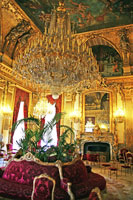
Napoleon III apartments
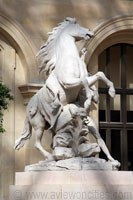
Marly Horse
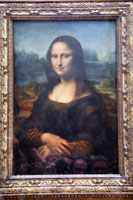
Mona Lisa
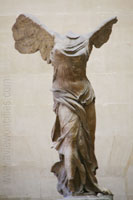
Winged Victory
Paintings from the Middle Ages up to the 19th century from across Europe are on the second floor of the Richelieu wing, including many works from master painters such as Rubens and Rembrandt. Some of the most notable works are the Lacemaker from Jan Vermeer and the Virgin of Chancellor Rolin, a 15th century work by the Flemish painter Jan van Eyck. The first floor of the Richelieu wing houses a collection of decorative arts, with objects such as clocks, furniture, china and tapestries.
On the same floor are the sumptuously decorated Napoleon III Apartments. They give you an idea of what the Louvre interior looked like when it was still in use as a royal palace.
The ground and lower ground floor are home to the Louvre's extensive collection of sculptures. They are arranged around two glass covered courtyards: Cour Puget and Cour Marly. The latter houses the Horses of Marly, large marble sculptures created in the 18th century by Guillaume Coustou. Nearby is the Tomb of Philippe Pot, supported by eight Pleurants ('weepers').
The ground floor also houses a collection of antiquities from the Near East. The main attraction here is the Code of Hammurabi, a large basalt stele from the 18th century BC, inscribed with the Babylonian law code.
On the same floor are the sumptuously decorated Napoleon III Apartments. They give you an idea of what the Louvre interior looked like when it was still in use as a royal palace.
The ground and lower ground floor are home to the Louvre's extensive collection of sculptures. They are arranged around two glass covered courtyards: Cour Puget and Cour Marly. The latter houses the Horses of Marly, large marble sculptures created in the 18th century by Guillaume Coustou. Nearby is the Tomb of Philippe Pot, supported by eight Pleurants ('weepers').
The ground floor also houses a collection of antiquities from the Near East. The main attraction here is the Code of Hammurabi, a large basalt stele from the 18th century BC, inscribed with the Babylonian law code.
Denon Wing
The Denon Wing is the most crowded of the three wings of the Louvre Museum; the Mona Lisa, a portrait of a woman by Leonardo da Vinci on the first floor is the biggest crowd puller. There are other masterpieces however, including the Wedding Feast at Cana from Veronese and the Consecration of Emperor Napoleon I by Jacques Louis David. Another star attraction of the museum is the Winged Victory of Samothrace, a Greek marble statue displayed at a prominent spot in the atrium connecting the Denon wing with the Sully wing.
The ground floor of the Denon wing houses the museum's large collection of Roman and Etruscan antiquities as well as a collection of sculptures from the Renaissance to the 19th century. Here you find Antonio Canova's marble statue of Psyche Revived by Cupid's Kiss. Even more famous is Michelangelo's Dying Slave. On the same floor are eight rooms with artifacts from Africa, Asia, Oceania and the Americas. Medieval sculptures from Europe are displayed on the lower ground floor of the Denon wing.
The ground floor of the Denon wing houses the museum's large collection of Roman and Etruscan antiquities as well as a collection of sculptures from the Renaissance to the 19th century. Here you find Antonio Canova's marble statue of Psyche Revived by Cupid's Kiss. Even more famous is Michelangelo's Dying Slave. On the same floor are eight rooms with artifacts from Africa, Asia, Oceania and the Americas. Medieval sculptures from Europe are displayed on the lower ground floor of the Denon wing.
History of the Louvre Palace
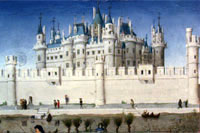
The Louvre in the 15th century
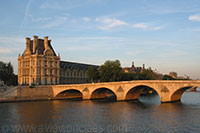
Louvre seen from across
the Seine
the Seine
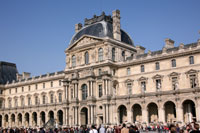
Richelieu Wing
The Louvre was created in several phases. Originally built as a 12th century fortress by King Philip II, it was significantly expanded in the 14th century during the reign of King Charles V.
Its current palatial appearance goes back to the late 15th century, when the original fortress was demolished and the wing along the Seine river was built. The palace was extended during the 16th century by architect Pierre Lescot, who expanded the palace into a complex with two courtyards. A decade later Catharina de Medici added the Tuileries Palace to the west of the Louvre. Construction on the Louvre was halted for some time when king Louis XIV decided to move to the Versailles Palace.
In the 19th century, during the Second Empire, the Louvre was expanded again with the addition of the Richelieu wing. The wings were extended even further westward during the Third Empire. The Louvre now had four symmetric wings surrounding a large courtyard. This would not last long, as the Communards burned the Tuileries Palace to the ground in 1871, opening up the west side of the palace.
Its current palatial appearance goes back to the late 15th century, when the original fortress was demolished and the wing along the Seine river was built. The palace was extended during the 16th century by architect Pierre Lescot, who expanded the palace into a complex with two courtyards. A decade later Catharina de Medici added the Tuileries Palace to the west of the Louvre. Construction on the Louvre was halted for some time when king Louis XIV decided to move to the Versailles Palace.
In the 19th century, during the Second Empire, the Louvre was expanded again with the addition of the Richelieu wing. The wings were extended even further westward during the Third Empire. The Louvre now had four symmetric wings surrounding a large courtyard. This would not last long, as the Communards burned the Tuileries Palace to the ground in 1871, opening up the west side of the palace.
Louvre Pyramid
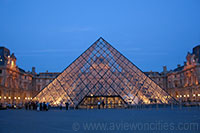
Louvre Pyramid
The most recent addition to the Louvre was the construction of the Louvre Pyramid, which functions as the museum's main entrance. The pyramid was built in 1989 by the renowned American architect I.M. Pei. The glass pyramid allows the sunlight to enter the underground floor.
The modern addition originally received mixed reviews, as it contrasts sharply with the classical design of the surrounding buildings, but today it is generally accepted as a clever solution which has given the museum a spacious central entrance without the need to touch the historic patrimony.
The modern addition originally received mixed reviews, as it contrasts sharply with the classical design of the surrounding buildings, but today it is generally accepted as a clever solution which has given the museum a spacious central entrance without the need to touch the historic patrimony.
Not the largest cathedral in the world, the Notre-Dame might be the most famous of all cathedrals. The Gothic masterpiece is located on the Île de la Cité, a small island in the heart of the city.
A Religious site
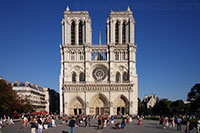
Notre Dame de Paris
The site of the Notre dame is the cradle of Paris and has always been the religious center of the city. The Celts had their sacred ground here, the Romans built a temple to worship Jupiter. A Christian basilica was built in the 6th century and the last religious structure before the Notre-Dame construction started was a Romanesque church.
Construction
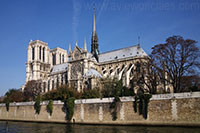
Bishop Maurice de Sully started the construction in 1163. The Cathedral was to be built in the new Gothic style and had to reflect Paris's status as the capital of the Kingdom France. It was the first cathedral built on a monumental scale and became the prototype for future cathedrals in France, like the cathedrals of Amiens, Chartres or Rheims, just to name the most famous.
The Building
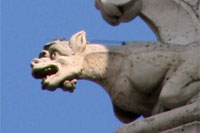
Gargoyle
It took until 1345 before the cathedral was completed, partly because the design was enlarged during construction. The result is an overwhelming building, 128m long (420 ft) with two 69 meter tall towers (226 ft). The spire, which reaches 90m (295 ft), was added in the 19th century by Viollet-le-Duc. The Notre-Dame Cathedral has several large rose windows, the northern 13th century window is the most impressive. The massive window has a diameter of 13.1 meter.
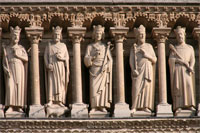 The frontal west facade features three wide portals; above the portals is the Gallery of Kings - 28 statues of Judean Kings - and higher up are the famous gargoyles and grotesques. The spectacular eastern flying buttresses at the east side of the building are 15m wide.
Gallery of Kings
Restoration
During the Revolution, many of the cathedral's sculptures, gargoyles and interior was removed or demolished. Even the gallery of Kings was severely damaged: the revolutionaries though the statues represented
 French Kings.
It wasn't until the 19th century before the Cathedral was fully restored thanks in part to the writer Victor Hugo, who with his book 'Notre-Dame de Paris', made the Parisians realise the cathedral was worth restoring. The 20 year long restoration was led by a local architect, Eugène Emmanuel Viollet-le-Duc. Viollet-le-Duc made drastic, controversial modifications to the building and even added a spire. The cathedral was restored again between 1991 and 2001, this time the historic architecture was carefully preserved.
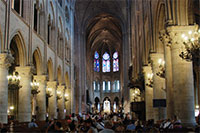
Inside the cathedral
It wasn't until the 19th century before the Cathedral was fully restored thanks in part to the writer Victor Hugo, who with his book 'Notre-Dame de Paris', made the Parisians realise the cathedral was worth restoring. The 20 year long restoration was led by a local architect, Eugène Emmanuel Viollet-le-Duc. Viollet-le-Duc made drastic, controversial modifications to the building and even added a spire. The cathedral was restored again between 1991 and 2001, this time the historic architecture was carefully preserved.
The Avenue des Champs-Elysées is probably the most famous avenue in the world. This impressive street stretches from the Place the la Concorde to the Place Charles de Gaulle, the site of the Arc de Triomphe.
Orientation
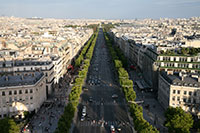
Champs-Elysées seen
from the Arc de Triomphe
from the Arc de Triomphe
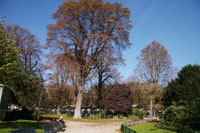
Jardins des Champs-Elysées
The Champs-Elysées is almost two kilometers long and seventy meters wide. At its western end the street is bordered by cinemas, theaters, cafés and luxury shops. On the opposite end, near the Place de la Concorde, the street is bordered by the Jardins des Champs-Elysées, beautifully arranged gardens with fountains and some grand buildings including the Grand and Petit Palais at the southern side and the Elysée at its northern side. The latter has been the residence of the French Presidents since 1873.
Celebrations
The Champs-Elysées is used for all the major celebrations. This is where Parisians celebrate New Year's Eve and where the military parades are held on the 14th of July. Historic national events, like the Liberation at the end of the second World War or the victory in the World Cup football were also celebrated on this wide avenue.
Seventeenth century - The Elysian Fields
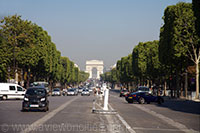
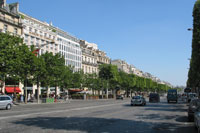
Champs-Elysées
In the sixteenth century this area was nothing but fields outside the center of Paris. In 1616 Marie de Medicis decided to create a long tree-lined path going east from the Tuileries. The route was redesigned in 1667 by renowned landscape designer André Le Nôtre as an extension of the Jardins des Tuileries. The promenade, now called 'Grande Allée du Roule' or 'Grand-Cours' had become a fashionable place but was still isolated from the city with few buildings surrounding the area.
Twenty-seven years later the promenade was renamed to 'Champs-Elysées', or Elysian Fields in English. The name was derived from Greek mythology where 'Elusia' is a place where heroes come to relax.
Twenty-seven years later the promenade was renamed to 'Champs-Elysées', or Elysian Fields in English. The name was derived from Greek mythology where 'Elusia' is a place where heroes come to relax.
Eighteenth & nineteenth centuries - Further Development
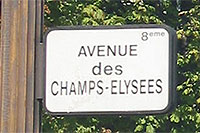
In 1724 the Champs-Elysées was extended all the way to the Chaillot hill (now known as l'Etoile, the site of the Arc de Triomphe). Its current form took shape in 1838 when French architect Ignaz Hittorf - who was redesigning thePlace de la Concorde - created the Jardins des Champs-Elysées. He also installed sidewalks, gas lamps and fountains. The Champs-Elysées started to attract more and more restaurants and hotels, especially after 1900 when the Paris metro line nr 1 reached the Etoile station.
Current Design
The lastest redesign of the prestigious avenue was done in 1994 by Bernard Huet. The side lanes were converted into pedestrian zones, an underground parking lot was created and new trees were planted. Cars now only occupy half the width of this grand avenue.
In the middle of the Place Charles de Gaulle, at the border of the 8th, 16th and 17th arrondissement stands one of the greatest arches in history: the Arc de Triomphe (arch of triumph).
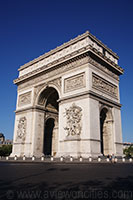
Arc de Triomphe
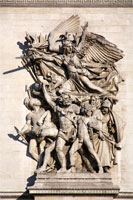
Marseillaise relief
Napoleon's Triumphal Arch
The arch was commissioned by Napoleon in 1806 to commemorate his victories, but he was ousted before the arch was completed. In fact, it wasn't completed until 1836 during the reign of Louis-Philippe. The Arc de Triomphe is engraved with names of generals who commanded French troops during Napoleon's regime.
Design
The design of the arch by Jean Chalgrin is based on the Arch of Titus in Rome. The Arc de Triomphe is much higher (50m versus 15m), but it has exactly the same proportions.
The triumphal arch is adorned with many reliefs, most of them commemorating the emperor's battles. Among them are the battle of Aboukir, Napoleon's victory over the Turkish and the Battle of Austerliz, where Napoleon defeated the Austrians.
The best known relief is the Departure of the Volunteers in 1792, also known as the Marseillaise. At the top of the arch are thirty shields, each of them bears the name of one of Napoleon's successful battles.
Below the arch is the Grave of the Unknown Soldiers, honoring the many who died during the First World War.
The triumphal arch is adorned with many reliefs, most of them commemorating the emperor's battles. Among them are the battle of Aboukir, Napoleon's victory over the Turkish and the Battle of Austerliz, where Napoleon defeated the Austrians.
The best known relief is the Departure of the Volunteers in 1792, also known as the Marseillaise. At the top of the arch are thirty shields, each of them bears the name of one of Napoleon's successful battles.
Below the arch is the Grave of the Unknown Soldiers, honoring the many who died during the First World War.
Place Charles de Gaulle
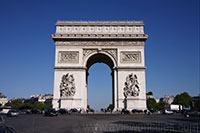
The arch is located at the end of theChamps-Elysées, in the middle of the Place Charles de Gaulle, a large circular square from which no less than 12 streets emanate. The streets are named after French military leaders.
Observation deck
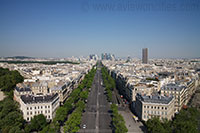
View from Arc de Triomphe
The Sacré-Coeur Basilica is one of Paris's major tourist draws. The majestic building is located on top of the Montmartre hill.
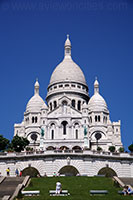
Sacré-Coeur
Montmartre
Above all, Montmartre, an area on a hill in the 18th arrondissement, north of downtown Paris, is known for its many artists who have been omnipresent since 1880. The name Montmartre is said to be derived from either Mount of Martyrs or from Mount of Mars. Until 1873, when the Sacré-Coeur was built on top of the hill,Montmartre was a small village, inhabited by a mostly farming community.
The Basilica Project
The project to build the Sacré-Coeur Basilica (Basilica of the Sacred Heart) was initiated by a group of influential people. Their reasons to build this monument was two-fold:
 they had pledged to build a church if Paris escaped unscathed from the war with the Prussians and they saw the defeat of the French at the hands of the Prussian army in 1870 as a moral condemnation of the sins of Paris.
The project was authorized by the National Assembly in 1873, and a competition was organized. The goal was to build an imposing basilica true to Christian traditions.
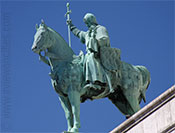
King Louis IX
The project was authorized by the National Assembly in 1873, and a competition was organized. The goal was to build an imposing basilica true to Christian traditions.
The Building
The winner of the competition was Paul Abadie, who had already restored two cathedrals in France. He designed an immense basilica in a Roman-Byzantyne style. This architectural style stands in sharp contrast with other contemporary buildings in France,
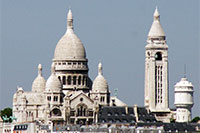 which were mostly built in a Romanesque style.
Construction of the Basilica started in 1876 with Abadie as the lead architect. When Paul Abadie died in 1884, he was succeeded by Lucien Magne, who added an 83 meter (272 ft) tall clock tower. The Savoyarde clock installed here is one of the world's largest.
Due to its location on the Montmartre hill, the basilica towers over the city; its highest point is even higher than the top of the Eiffel Tower. Thanks to this prominent location the Sacré-Coeur Basilica is one of the most
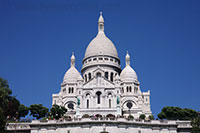 noticeable landmarks in Paris.
View from the
Parc des Buttes-Chaumont
Parc des Buttes-Chaumont
Construction of the Basilica started in 1876 with Abadie as the lead architect. When Paul Abadie died in 1884, he was succeeded by Lucien Magne, who added an 83 meter (272 ft) tall clock tower. The Savoyarde clock installed here is one of the world's largest.
Due to its location on the Montmartre hill, the basilica towers over the city; its highest point is even higher than the top of the Eiffel Tower. Thanks to this prominent location the Sacré-Coeur Basilica is one of the most
White Stones
The Sacré-Coeur Basilica has managed to keep its beaming white color even in the polluted air of a big city like Paris. This can be attributed to the Château-Landon stones which were used for the construction of the Sacré-Coeur. When it rains, the stones react to the water and secrete calcite, which acts like a bleacher.
The magnificent Château de Versailles is a testimony of the Sun King's extravaganza. The Palace and its magnificent formal garden became the quintessential model for palaces in Europe.
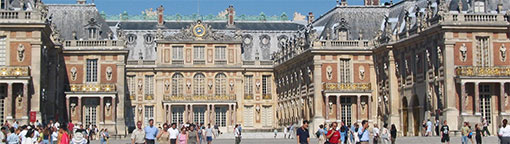
Brief History
The town of Versailles sits about 20 kilometers outside of Paris. The first mention of the town and estate was in 1038, when the name appeared in a charter of the Abbey of Saint-Père de Chartres. By the end of the
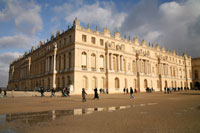 11th century, Versailles was a country village enveloping a castle and the church of Saint-Julien, remaining prosperous until well into the 13th century. After the Hundred Years War, however, only a handful of people lived there.
Versailles Palace
Royal Presence
In the 16th century, the Gondi family became the rulers of Versailles and the town began to gain acclaim when future King Louis XIII visited and became enamored with the site. He purchased land in the area and proceeded to build a small brick and stone lodge there in 1622.
 Ten years later, he became the lord of Versailles and began enlarging his lodge. Soon, he purchased more land as well as Gondi's estate. Louis XIII dies in 1643.
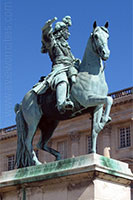
Statue of Louis XIV
The Sun King
In 1662, the new king - Louis XIV - took an earnest interest in Versailles. Louis XIV, also known as The Sun King, distrusted the Parisians and wanted to move his Royal Residence away from the Louvre Palace, which was at the heart of constant political turbulence. The Sun King was largely responsible for the expansion that resulted in the building that still stands today. He hired architect Louis Le Vau along with artist Charles Le Brun to carry out the work on this Baroque masterpiece, which became the quintessential model for all palaces in Europe. Famed gardener André le Nôtre was responsible for the unequalled Versailles Garden.
Royal Chapel
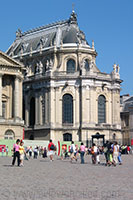
After Le Vau's death, Jules Hardouin- Mansart was commissioned to triple the size of the palace. Under his watchful eye, the northern and southern wings, the Orangerie, the Grand Trianon (a chateau) and the Royal Chapel were constructed. Later additions included the Opera and the Petit Trianon (a small chateau), which was built between the years 1761 - 1764 for Louis XV and Madame de Pompadour.
The French Revolution
During the French Revolution, the incredible collection of paintings, antiques, and other works of art that had been amassed at Versailles were transferred to the Louvre and other important items went to the National Library and Conservatory of Arts and Crafts. Most of the furniture, historians say, was sold at auction.
A Palatial Museum
Royal palace
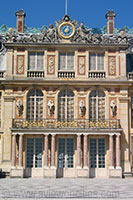
After the Revolution, Napoleon spent his summers at Versailles until he abdicated. Later, it was Louis-Phillipe who, in 1830, transformed the chateau into a grand museum, dedicated to "the glory of France." The Chapel, the Opera, and the Hall of Mirrors were preserved but many smaller apartments were destroyed to make room for spacious exhibition halls. In the 1960s, however, curator Pierre Verlet was responsible for getting some of the furnishings back and restoring a number of the royal apartments.
Today, visitors to Versailles can visit much of the interior of this spectacular palace, as well as its world-famous garden.
Interior
Notable rooms include:
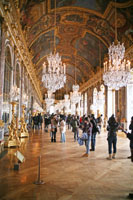
- The Hall of Mirrors - Some call this Louis XIV's most notable contribution to Versailles. The main feature of the hall is the seventeen mirrored arches that reflect the seventeen arcaded windows which look out onto Versailles equally- magnificent garden. Each arch contains twenty-one mirrors, for a total of 357 in all. This magnificent hall measures 73 meters long, 10.5 meters wide, and 12.3 meters high (240x34x40ft). Statues and busts line the walls. The Hall of Mirrors has always played an important role in history including in 1919, as the First World War officially ended when Germany signed the Treaty of Versailles in this hall.
 Hall of Mirrors
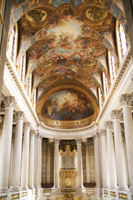
 - Chapel of Versailles - The current chapel of Versailles is the fifth at the palace. Construction began in 1689 and was completed around 1710. It features a "tribune" on the same level as the royal apartments, overlooking the nave, where the kings would sit when they attended mass. The architecture is a combination of Gothic and Baroque. Many of its features resemble cathedrals of medieval times, including the gargoyles and pointed roof, but other features are more reminiscent of the era in which it was built, including colored marble tile floors, columns, and carved pillars.
 Royal Chapel
 - The Grand Apartment - Originally known as the Apartment of the Planets (the 7 salons of this apartment each featured a painting of a planet), this was King Louis XIV's apartment. While the entire apartment and all its salons are amazing, most notable are the ceilings, painted by Painter to the King, Charles Le Brun and his team of artists.
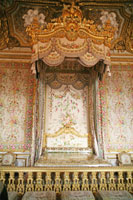 The Queen's bedroom
 - Royal Opera - The auditorium of the Opera is fashioned entirely from wood, making it one of the most acoustically "live" theaters in the world. Though it was a court theater and not meant for a huge public audience, it seats more than 700. Gold, pink, and green dominate the decor for the Opera, which wasn't constructed until 1770. It was first used for the wedding ball of future king Louis XVI and Marie Antoinette and boasts a unique mechanical system that raises the floor to the level of the stage. Today, it is still used for concerts and operas.
The Garden
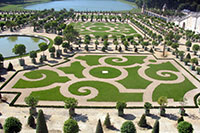
Geometric Garden
At 100 hectare (about 250 acre), the garden of the Versailles Palace is Europe's largest palace garden. It was created in the 17th century by landscape gardener André Le Nôtre who designed what could be considered the quintessential formal French garden. The garden is laid out in a geometric pattern of paths, bushes, flowerbeds and trees. Le Nôtre also drained the swampy, sloping terrain and created a series of basins and a large canal, known as the Grand Canal.
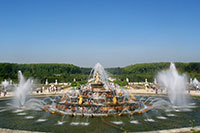 Several fountains adorn the basins. The most famous are the Latona Fountain - with a statue of the goddess Latona - and the Apollo Fountain - named after the sun god and depicting the Sun King riding a chariot. There are several other fountains in the garden, such as the Neptune Fountain. The fountains were installed to entertain the many guests invited to the lavish parties organized by King Louis XIV.
Another noteworthy decoration in the garden is the Colonnade, a circular row of marble columns, designed by Jules Hardouin-Mansart.
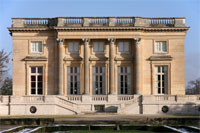 There are also a couple of smaller palaces in the garden: the Grand Trianon and the Petit Trianon. Some 10,000 people worked in the Versailles Palace, so privacy was minimal. Hence King Louis XIV ordered the construction of the Grand Trianon, a palace almost as luxurious as the main palace where the king could escape the formalities of the court and arrange rendezvous with his mistress. His successor, king Louis XV later built the smaller Petit Trianon for the same reason.
Latona Fountain
Another noteworthy decoration in the garden is the Colonnade, a circular row of marble columns, designed by Jules Hardouin-Mansart.
Petit Trianon
The Jardin du Luxembourg is probably the most popular park in Paris. The park, situated near the Latin Quarter, offers a lot of variety and attracts all kinds of people, from students and parents with children to tourists.
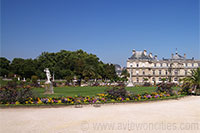

Jardin du Luxembourg
The 22.45 hectare large park (about 55 acres) can get pretty crowded when the sun comes out. Students come here to rehearse their courses, neighbors come here for a stroll and like with all great places in Paris, there are always plenty of tourists. But despite its popularity, the Jardin du Luxembourg is plenty enjoyable and a welcome relief from the crowded Parisian streets.
History
The park was originally owned by the duke of Luxembourg, hence the name. The domain was purchased in 1612 by Marie de' Medici, the widow of King Henry IV. After the king was murdered in 1610 she decided to move out from the Louvre to a new residence.
Marie de' Medici was of Italian descent and had spent her youth in Florence at the Pitti Palace. The Boboli garden at this palace was the inspiration for the Jardin du Luxembourg.
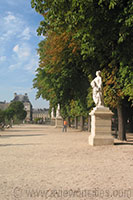 She commissioned Salomon de Brosse with the construction of a new palace and had the garden laid out in Italian fashion. At the time the garden was quite small due to the existence of a Carthusian monastery to the south of the palace. Despite the insistence of Marie de' Medici the Carthusians refused to leave and the garden stretched no further than the current octagonal pond.
Almost two hundred years later, during the French Revolution, the Carthusians were forced to leave when revolutionaries confiscated the monastery. This paved the way for a significant expansion of the gardens and a redesign in a more French style. Baron Haussmann, during his massive urban renewal of Paris in the mid nineteenth century, nibbled at the edges of the park, but it is still one of the largest green spaces in the center of Paris.
Marie de' Medici was of Italian descent and had spent her youth in Florence at the Pitti Palace. The Boboli garden at this palace was the inspiration for the Jardin du Luxembourg.
Almost two hundred years later, during the French Revolution, the Carthusians were forced to leave when revolutionaries confiscated the monastery. This paved the way for a significant expansion of the gardens and a redesign in a more French style. Baron Haussmann, during his massive urban renewal of Paris in the mid nineteenth century, nibbled at the edges of the park, but it is still one of the largest green spaces in the center of Paris.
The Park
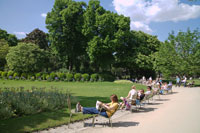
Relaxing in the park
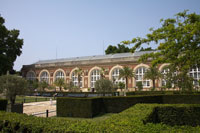
Orangery
In the middle of the park is a large octagonal pond, known as the Grand Bassin. Here, children can rent small boats. The Jardin du Luxembourg boasts many other attractions for children such as a puppet theater, pony rides, a merry-go-round and a large playground.
Around the pond are nice lawns, paths, and some of Paris's most beautiful flower beds, all laid out in a geometrical pattern and enclosed by a balustrade. Numerous statues adorn the park. This is also one of the parks where you can simply get hold of one of the many chairs and take it to the exact spot where you want to sit. The park is also popular with chess players and jeu de boules players. There's also a tennis court, a music pavilion and an orangery in the park. Right behind the orangery is the Musée du Luxembourg, a museum that is only open for temporary exhibitions.
Around the pond are nice lawns, paths, and some of Paris's most beautiful flower beds, all laid out in a geometrical pattern and enclosed by a balustrade. Numerous statues adorn the park. This is also one of the parks where you can simply get hold of one of the many chairs and take it to the exact spot where you want to sit. The park is also popular with chess players and jeu de boules players. There's also a tennis court, a music pavilion and an orangery in the park. Right behind the orangery is the Musée du Luxembourg, a museum that is only open for temporary exhibitions.
Fountains
The Jardin du Luxembourg features several noteworthy fountains. The most famous one is the Fontaine Médicis, a romantic Baroque fountain designed in the early seventeenth century.
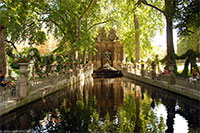 It is located at the end of a small pond at the northeast side of the park. A central sculpture group shows the Greek mythological figure of Polyphemus who observes the lovers Acis and Galatea. It is flanked by allegorical figures depicting the rivers Seine and Rhône.
Very few people realize that there's another fountain, the Fontaine de Léda, at the back of the Fontaine Médicis. This fountain was created in 1806. A relief shows a mythical scene with Leda and Zeus disguised as a swan.
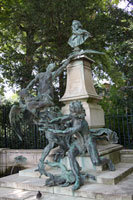 There's a third fountain on the other, west side of the palace. It honors the French painter Eugène Delacroix and consists of a rectangular basin with six jets. At the center is a tall pedestal with a bust of the painter. Sensual allegorical statues of Time, Glory and Genius stretch from a plinth towards the bust.
At the southern end of the park, in an extension known as the Jardins de l'Observatoire, is yet another fountain, the Fontaine de l'Observatoire. The monumental fountain was created in 1873 by Davioud, Carpaux and Frémiet. The centerpiece of the fountain shows a globe supported by four women, each representing a continent.
Fontaine Médicis
Very few people realize that there's another fountain, the Fontaine de Léda, at the back of the Fontaine Médicis. This fountain was created in 1806. A relief shows a mythical scene with Leda and Zeus disguised as a swan.
Fontaine Delacroix
At the southern end of the park, in an extension known as the Jardins de l'Observatoire, is yet another fountain, the Fontaine de l'Observatoire. The monumental fountain was created in 1873 by Davioud, Carpaux and Frémiet. The centerpiece of the fountain shows a globe supported by four women, each representing a continent.
Statues

La Liberté
There are almost seventy statues and monuments scattered around the park. Among them are twenty statues of French Queens, including Marie de' Medici. The patroness of Paris, Sainte-Geneviève, is another woman whose effigy you can find here. Many of the statues in the Jardin du Luxembourg honor famous (mostly French) people, from politicians and scientists over sculptors and painters to poets and composers like Chopin and Beethoven. Other statues depict animals or are inspired by mythology, such as the Dancing Faun.
Many visitors will be surprised to see La Liberté, a miniature version of the Statue of Liberty created by Auguste-Bartholdi himself. And there's also a bit of Rome in the Jardin du Luxembourg thanks to the Bocca della Verità monument, which depicts a woman who puts her hand in the Mouth of Truth.
Many visitors will be surprised to see La Liberté, a miniature version of the Statue of Liberty created by Auguste-Bartholdi himself. And there's also a bit of Rome in the Jardin du Luxembourg thanks to the Bocca della Verità monument, which depicts a woman who puts her hand in the Mouth of Truth.
The Palace
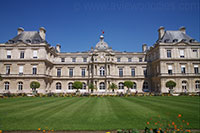
Palais du Luxembourg
Between 1615 and 1627 the Palais du Luxembourg (Luxembourg Palace) was constructed at the northern end of the Jardin du Luxembourg.
The palace was built for Marie de' Medici, who was nostalgic about her youth at the Pitti Palace in Florence, so she asked the architect, Salomon de Brosse, to look at the Pitti Palace for inspiration, hence the Florentine style of the palace. The widowed queen did not get the time to enjoy her new palace and gardens for long as she was banished by Richelieu in 1625, before the palace was completed.
In 1794, during the French Revolution, the palace served as a prison. It also served as the headquarters of the Luftwaffe during the Second World War. The building currently houses the French Senate.
The palace was built for Marie de' Medici, who was nostalgic about her youth at the Pitti Palace in Florence, so she asked the architect, Salomon de Brosse, to look at the Pitti Palace for inspiration, hence the Florentine style of the palace. The widowed queen did not get the time to enjoy her new palace and gardens for long as she was banished by Richelieu in 1625, before the palace was completed.
In 1794, during the French Revolution, the palace served as a prison. It also served as the headquarters of the Luftwaffe during the Second World War. The building currently houses the French Senate.
At eight hectares (20 acres), the octagonal Place de la Concorde is the largest square in Paris. It is situated between the Tuileries and the Champs-Elysées.
Creation
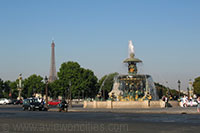
Place de la Concorde
In 1763, a large statue of king Louis XV was erected at this site to celebrate the recovery of the king after a serious illness. The square surrounding the statue was created later, in 1772, by the architect Jacques-Ange Gabriel. It was known as the place Louis XV.
Guillotine
In 1792, during the French revolution, the statue was replaced by a another, large statue, called 'Liberté' (freedom) and the square was called Place de la Révolution. A guillotine was installed at the center of the square and in a time span of only a couple of years, 1119 people were beheaded here. Amongst them many famous people like King Louis XVI, Marie-Antionette, and
 revolutionary Robespierre, just to name a few. After the revolution the square was renamed several times until 1830, when it was given the current name 'Place de la Concorde'.
Cleopatra's Needle
Obelisk
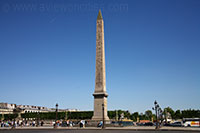
In the 19th century the 3200 years old obelisk from the temple of Ramses II at Thebes was installed at the center of the Place de la Concorde. It is a 23 meters (75 ft) tall monolith in pink granite and weighs approximately 230 tons. In 1831, it was offered by the Viceroy of Egypt to Louis Philippe.
 Three obelisks wereoffered by the Viceroy, but only one was transported to Paris.
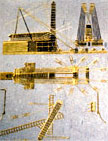
The obelisk - sometimes dubbed 'L'aiguille de Cléopâtre' or Cleopatra's Needle - is covered with hieroglyphs picturing the reign of pharaohs Ramses II & Ramses III. Pictures on the pedestal describe the transportation to Paris and its installation at the square in 1836.
Obelisk's pedestal
The obelisk - sometimes dubbed 'L'aiguille de Cléopâtre' or Cleopatra's Needle - is covered with hieroglyphs picturing the reign of pharaohs Ramses II & Ramses III. Pictures on the pedestal describe the transportation to Paris and its installation at the square in 1836.
Statues & Fountains
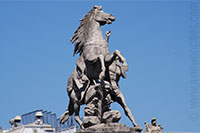
Statue of galloping horse
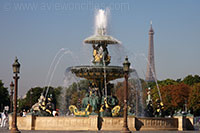
Fontaine des Mers
At each corner of the octagonal square is a statue representing a French city: Bordeaux, Brest, Lille, Lyon, Marseille, Nantes, Rouen and Strasbourg. They were installed in 1836 by Jacob Ignaz Hittorf, who redesigned the Place de la Concorde between 1833 and 1846. That same year a bronze fountain, called 'La fontaine des Mers' was added to the square. A second one, the 'Elevation of the Maritime' fountain, was installed in 1839. Both fountains were designed by Hittorf.
Orientation
From the Place de la Concorde you can see the Arc de Triomphe (west), the Madeleine (north), the Tuileries (east) and, across the Seine, the Palais Bourbon, now the Assemblée Nationale(south).
